

The southern Appalachians hold more kinds of trees than almost any other temperate forest in the world. Great Smoky Mountains National Park alone has about 100 native tree species, more than any other national park in North America. On a single drive up the Blue Ridge Parkway from the foothills to Mount Mitchell, you pass through forests that, at sea level, would be spread from Georgia to Canada.
This guide explains why the region has so many trees, how the forests change with elevation, and how to recognize the trees you are most likely to see. It also covers where to find old-growth forest and record-sized trees, when the fall color comes, and what is happening to the forest now: the insects and diseases killing some species, the long effort to bring back the American chestnut, and the damage Hurricane Helene left in 2024. Where this site has its own guide to a place, the text links to it.
At a Glance
WHAT IT COVERS The native trees and forests of the mountains of Virginia, North Carolina, Tennessee, Georgia, and South Carolina, from the river valleys to the spruce-fir forests on the highest peaks.
NATIVE TREES About 100 species in Great Smoky Mountains National Park, the most of any national park in North America.
TALLEST TREE The Fork Ridge Tuliptree in the Smokies, measured at 191.9 feet in 2011, the tallest known tree in eastern North America.
OLD GROWTH About a quarter of the Smokies’ forest has never been logged. Outside the park, Joyce Kilmer Memorial Forest is the best-known stand.
FALL COLOR Starts on the highest peaks in late September or early October, peaks around Boone in mid-October, and reaches the foothills in early November.
THREATS Hemlock woolly adelgid, emerald ash borer, beech leaf disease, chestnut blight, and the spotted lanternfly, which reached the mountains in 2025.
AFTER HELENE The storm damaged about 822,000 acres of forest in western North Carolina. Much of it is regrowing, and the fallen timber will raise the wildfire risk for years.
ONLINE GUIDES FALL COLOR REPORTS | NC FOREST HEALTH | HEMLOCK RESTORATION | AMERICAN CHESTNUT FOUNDATION | REPORT A LANTERNFLY
The Forests
- Why there are so many trees here
- The forests, from the valleys to the peaks
- Conifers
- Trees of the coves
- Oaks, hickories, and the ridges
- Trees of the high elevations
- Flowering and understory trees
- The American chestnut
- Fraser fir and the Christmas tree farms
Seeing the Trees
Why there are so many trees here
Three things account for most of it: age, elevation, and rain.
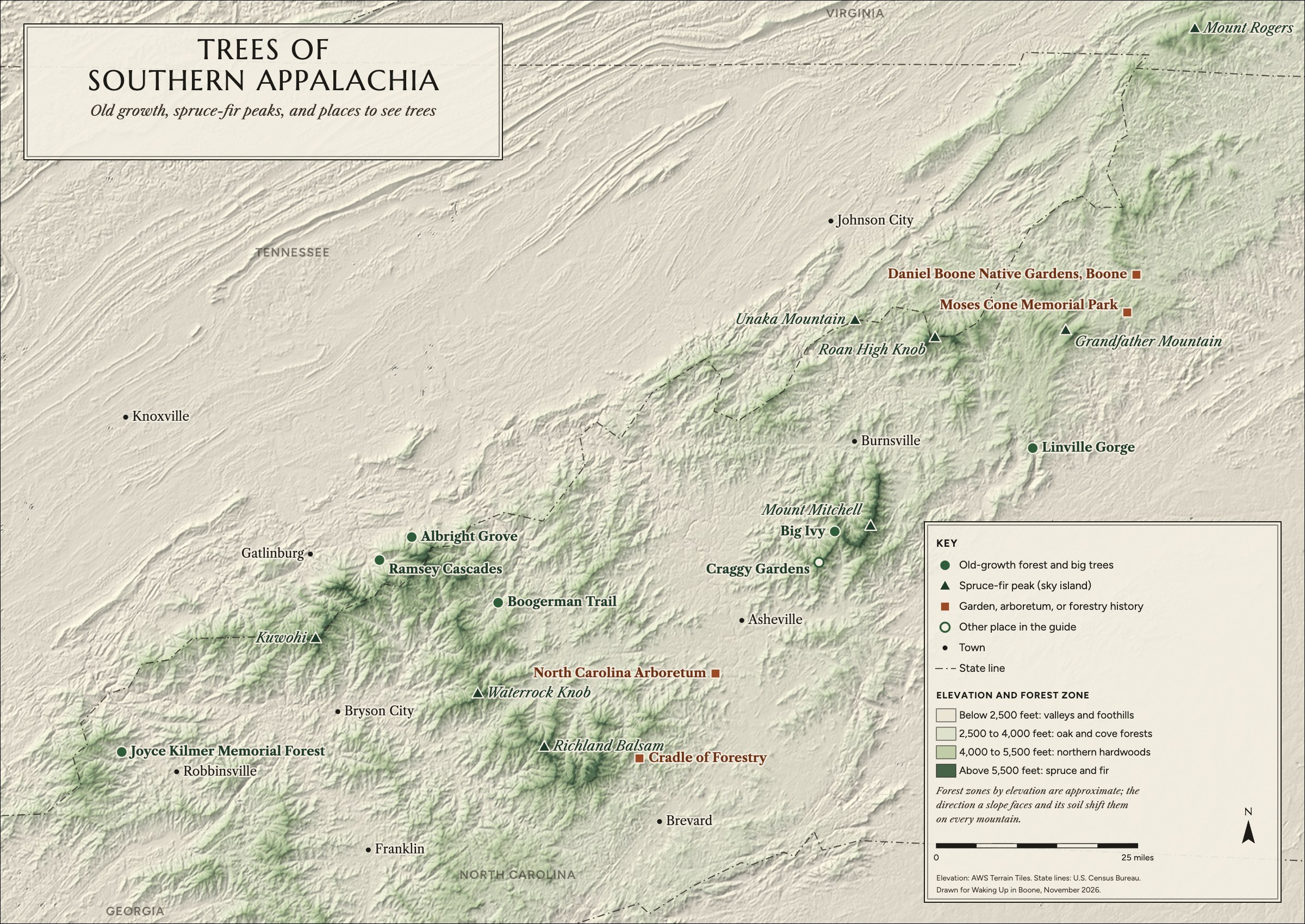
The Appalachians are among the oldest mountains on earth, and the southern part of the range was never covered by ice. During the ice ages, glaciers pushed northern trees south, and the southern mountains became a refuge where they could survive. When the climate warmed, many of those northern trees retreated up the mountainsides rather than north. That is why red spruce and Fraser fir, trees of a Canadian-type forest, grow on the tops of Mount Mitchell, Roan Mountain, and the high Smokies. The U.S. Fish and Wildlife Service counts eight of these “sky islands” of spruce and fir in the southern Appalachians, from the Great Smoky Mountains in the southwest to Mount Rogers and Whitetop in Virginia.
Elevation does the rest of the sorting. The region runs from under 1,000 feet in the valleys to 6,684 feet on Mount Mitchell, and climbing 1,000 feet has about the same effect on temperature as driving several hundred miles north. The mountains also catch moisture moving in from the Gulf of Mexico. Parts of the Blue Ridge escarpment and the high Smokies average more than 80 inches of rain a year, among the highest totals in the eastern United States, and the wettest coves are close to temperate rainforest.
Within any one mountain, the trees change with the direction a slope faces and how much water it holds. A north-facing cove a few hundred yards from a dry, south-facing ridge can hold an entirely different forest.
The forests, from the valleys to the peaks
Botanists divide the region’s forests in many ways. These six types cover most of what a visitor sees.
- Streamside forest. Along rivers and creeks at low and middle elevations: sycamore, river birch, and eastern hemlock, with thickets of rhododendron underneath. Many of the hemlocks along streams have died; see Insects and diseases.
- Cove hardwood forest. In sheltered, moist valleys and hollows up to about 4,500 feet. This is the richest forest in the region, with tulip poplar, yellow buckeye, sugar maple, basswood, silverbell, and many other species mixed together, and a heavy wildflower bloom in spring. The biggest hardwoods in the East grow in old-growth coves.
- Oak forest. On the middle slopes and broad ridges, the most widespread forest in the region. Chestnut oak, white oak, northern red oak, and hickories dominate. Before the blight, the American chestnut was a major tree here.
- Pine and oak heath. On the driest, sunniest ridges and rock outcrops: pitch pine, Table Mountain pine, scarlet oak, and chestnut oak over mountain laurel and blueberry. These forests depend on fire.
- Northern hardwood forest. From about 4,500 feet up to the spruce-fir zone: American beech, yellow birch, yellow buckeye, and sugar maple. On some high gaps and slopes, beech grows almost alone in low, wind-shaped stands called beech gaps. On exposed ridges, northern red oak grows short and twisted, sometimes called an oak orchard.
- Spruce-fir forest. On the highest peaks. Red spruce grows from about 4,500 feet up; Fraser fir takes over near the summits. These dark, mossy forests are home to the endangered Carolina northern flying squirrel and spruce-fir moss spider.
Two kinds of open land break up the forest at high elevations. Grassy balds, like those in the Roan Highlands, hold grasses and sedges. Heath balds, like those at Craggy Gardens, are covered with rhododendron, mountain laurel, and other shrubs. In mountain speech, “laurel” often means rhododendron and “ivy” means mountain laurel; a “laurel hell” is a rhododendron thicket too dense to walk through.
Conifers
- Red spruce (Picea rubens). Short, stiff, four-sided needles that grow all the way around the twig and roll easily between your fingers. Cones hang down. Common above about 4,500 feet. Much of the high-elevation spruce was logged and burned in the early 1900s, and replanting it is the main work of the Southern Appalachian Spruce Restoration Initiative.
- Fraser fir (Abies fraseri). Found in the wild only in the southern Appalachians, on the highest peaks. Its needles are flat and soft, with two silvery bands underneath, and its cones stand upright on the branches. Resin blisters on the smooth bark of young trees give it the local name “she-balsam.” It is also the North Carolina Christmas tree; see below.
- Eastern hemlock (Tsuga canadensis). Short, flat needles with two white lines underneath, arranged in two rows along the twig, and small cones about an inch long. It grows along streams and in shady coves, and it is one of the longest-lived and largest trees in the region. Most large hemlocks in the region have died or are declining from the hemlock woolly adelgid, except where they have been treated.
- Carolina hemlock (Tsuga caroliniana). Found only in the southern Appalachians, on dry, rocky ridges and cliffs, including Linville Gorge. Its needles stick out in all directions around the twig instead of lying in two rows. It is also threatened by the adelgid.
- Eastern white pine (Pinus strobus). The only native pine here with needles in bundles of five. Soft, long needles and long, slender cones. It is the tallest conifer in the East.
- Pitch pine and Table Mountain pine (Pinus rigida and Pinus pungens). Both grow on dry ridges and rock outcrops. Pitch pine has needles in threes. Table Mountain pine, which grows almost only in the Appalachians, has needles in twos and heavy cones armed with hooked spines. Many of its cones stay closed until a fire opens them, so the tree declines where fire is kept out.
- Virginia pine (Pinus virginiana). Short, twisted needles in pairs. Common at lower elevations on old fields and dry slopes.
Trees of the coves
- Tulip poplar (Liriodendron tulipifera). Not a true poplar but a member of the magnolia family. Its leaf has four lobes and a flat, squared-off tip, and its green and orange flowers open in late spring, often too high to see until they fall. It grows fast, straight, and tall; the tallest known tree in eastern North America is a tulip poplar in the Smokies.
- Yellow buckeye (Aesculus flava). Leaves with five leaflets spread like the fingers of a hand. It grows large in coves and at high elevations and is one of the first trees to drop its leaves in fall. The nuts are poisonous to people.
- Sugar maple (Acer saccharum). Five-lobed leaves with smooth edges between the points. In fall it turns yellow, orange, or red. The carriage roads at Moses Cone Memorial Park and the coves of the Smokies have fine examples.
- Red maple (Acer rubrum). The most common tree in the eastern United States, at every elevation. Red flowers in late winter, red leaf stems, and reliable red color in fall.
- American basswood (Tilia americana). Large, heart-shaped leaves with a lopsided base. Its fragrant flowers in early summer draw so many bees that it was called the bee tree. Old basswoods often grow in a ring of sprouts around the trunk.
- Carolina silverbell (Halesia tetraptera). White, bell-shaped flowers hang from its branches in April. It grows larger in the coves of the Smokies than anywhere else.
- Fraser magnolia (Magnolia fraseri). A southern Appalachian tree with very large leaves that have two small lobes, like ears, at the base. Big white flowers in spring. Cucumber magnolia (Magnolia acuminata) has large leaves without the ears and green fruit shaped like a small cucumber.
- Black cherry (Prunus serotina). Dark bark broken into small, curled plates that look like burnt potato chips. Valued for furniture wood.
- White ash (Fraxinus americana). Leaves made of several leaflets in pairs, and bark in a pattern of diamond-shaped ridges. The emerald ash borer is killing ash trees throughout the region.
- Eastern hemlock also grows in many coves; see Conifers above.
Oaks, hickories, and the ridges
- Chestnut oak (Quercus montana). The common oak of dry slopes and ridges, with deeply furrowed bark and leaves with wavy, rounded teeth. It took over much of the ground the American chestnut held.
- Northern red oak (Quercus rubra). Bristle-tipped lobes and bark with long, flat-topped ridges that look like ski tracks. It grows tall in good soil and short and gnarled on high, windy ridges, as at Craggy Gardens.
- White oak (Quercus alba). Rounded lobes without bristles and light gray, flaky bark. It grows slowly and lives a long time, and its acorns are a main food for bears, deer, and turkeys.
- Scarlet oak and black oak (Quercus coccinea and Quercus velutina). Red oaks of dry slopes. Scarlet oak turns a deep red in fall.
- Hickories. Mockernut, pignut, and shagbark hickory grow with the oaks. Shagbark is easy to recognize by its bark, which peels off in long strips. Hickories turn gold in fall.
- Black walnut (Juglans nigra). Long leaves with many leaflets and round, green-husked nuts. Common near old homesites and on rich lower slopes. Butternut (Juglans cinerea), its rarer relative, has been reduced by a canker disease.
- Black locust (Robinia pseudoacacia). White, fragrant flowers in May and deeply furrowed bark. Its wood resists rot, and mountain farmers used it for fence posts.
Trees of the high elevations
- American beech (Fagus grandifolia). Smooth, gray bark and leaves that turn pale tan and often stay on young trees through winter. It forms the beech gaps of the high ridges. Beech bark disease is already in the North Carolina mountains, and beech leaf disease was found in the state in 2025.
- Yellow birch (Betula alleghaniensis). Bronze or silvery bark that peels in thin curls. A scraped twig smells like wintergreen. Its seeds often sprout on moss-covered rocks and logs, and the roots grow down around them, leaving old trees standing on legs. Sweet birch (Betula lenta), lower on the mountain, has dark, smooth bark and the same wintergreen smell.
- American mountain-ash (Sorbus americana). A small tree of the highest peaks with leaves of many leaflets and bright red berries in late summer. It is not related to the true ashes.
- Fire cherry (Prunus pensylvanica), also called pin cherry. A short-lived tree that springs up quickly after fire, logging, or windthrow. Expect to see more of it in high-elevation areas opened by Helene.
- Red spruce and Fraser fir top the highest peaks; see Conifers above.
Flowering and understory trees
- Serviceberry (Amelanchier species), called “sarvis” in the mountains. Its white flowers are usually the first tree blossoms of spring, appearing before the leaves, and they climb the mountains over several weeks.
- Eastern redbud (Cercis canadensis). Pink-purple flowers along bare branches in early spring, then heart-shaped leaves. Most common at lower elevations.
- Flowering dogwood (Cornus florida). White flowers in April and May and red leaves and berries in early fall. Dogwood anthracnose, a fungal disease, has killed many dogwoods in cool, shady mountain forests since the 1980s.
- Sourwood (Oxydendrum arboreum). Drooping sprays of small white flowers in July, the source of sourwood honey. It is one of the first trees to turn red in fall.
- American holly (Ilex opaca). Evergreen, spiny leaves and red berries in winter.
- American witch-hazel (Hamamelis virginiana). A small tree or shrub whose thin yellow flowers open in late fall, after the leaves drop.
- Rhododendron and mountain laurel. Usually shrubs, but in old stands they grow into small, twisted trees. Rosebay rhododendron blooms white to pink in early summer at low and middle elevations; Catawba rhododendron blooms purple on the high balds in June; mountain laurel blooms pink and white in late May and June.
Two non-native trees are common along roads and disturbed ground. Princess tree (Paulownia tomentosa) has huge leaves and purple flowers in spring. Tree-of-heaven (Ailanthus altissima) has long leaves of many leaflets and smells like burnt peanut butter when a leaf is crushed. Both spread aggressively, and tree-of-heaven is the favorite host of the spotted lanternfly.
The American chestnut
The American chestnut was once one of the most important trees in these mountains. It grew fast and large, its wood resisted rot, and its nuts fed people, livestock, and wildlife every fall. Mountain families built cabins and fences from it and sold the nuts for cash.
A fungus brought into the United States on Asian chestnut trees was found in New York in 1904, and the blight it causes spread through the whole range of the tree. By about 1950 the American chestnut was functionally extinct across its native range. The roots often survived, and they still send up sprouts. Hikers in the region regularly pass chestnut sprouts along trails, recognizable by long, narrow leaves with a sharp, curved tooth at the end of each vein. Most die back from the blight before they grow large enough to bear nuts.
The American Chestnut Foundation, based in Asheville, has worked since 1983 to breed a blight-resistant tree that is still mostly American chestnut. In February 2026, its scientists and partners published research in the journal Science showing that DNA sequencing can predict which young hybrid trees will be most resistant, which could shorten each round of breeding by years. A separate project at the State University of New York College of Environmental Science and Forestry is developing a genetically engineered chestnut. If you find a chestnut tree that has flowered or produced burs, the foundation asks for a sample; its website explains how to send one.
The chestnut’s place in the forest was taken mostly by oaks, hickories, and red maple. Gray, weathered chestnut logs, killed nearly a century ago, can still be found lying on the forest floor in the Smokies.
Fraser fir and the Christmas tree farms
The Fraser fir grows wild only on the high peaks of the southern Appalachians, but it is grown on farms across the High Country. North Carolina ranks second to Oregon in Christmas tree production. About 1,300 growers raise Fraser fir on roughly 40,000 acres, and Fraser fir makes up more than 96 percent of the state’s Christmas trees. Ashe, Avery, Alleghany, Watauga, Jackson, and Mitchell counties grow the most, and Ashe County at times grows more Christmas trees than any other county in the country. The Fraser fir has been North Carolina’s official Christmas tree since 2005, and the state’s farms have supplied many of the trees for the White House Blue Room.
A Fraser fir usually takes ten years or more to reach harvest size. The rows of conical trees on the hillsides around Boone, Jefferson, and Newland are one of the most recognizable landscapes in the region. Many farms open for choose-and-cut sales from the weekend before Thanksgiving through mid-December.
In the wild, the Fraser fir has had a harder century. The balsam woolly adelgid, a tiny insect from Europe, was found killing firs on Mount Mitchell in 1957. By the 1980s it had spread across the southern Appalachians and killed about two-thirds of the adult Fraser firs, leaving the high ridges covered with standing gray trunks. Young firs grew back among the dead trees, and surveys on Mount Mitchell and in the Smokies have since found the spruce-fir forest recovering, with the adelgid less of a problem than it once was. The firs on the farms are protected by spraying, which is not possible on the steep peaks.
Where to see old growth and big trees
Most of the southern Appalachians were logged between about 1880 and 1930. What was left uncut survived mostly in places too steep or remote to reach, or in land bought for parks before the loggers arrived. The best of it is in the Smokies, where about a quarter of the forest is old growth.
- Joyce Kilmer Memorial Forest, Nantahala National Forest, near Robbinsville. About 3,800 acres along Little Santeetlah Creek that were never logged, dedicated in 1936 as a memorial to Joyce Kilmer, the author of the poem “Trees,” who was killed in World War I. A two-mile figure-eight trail loops through Poplar Cove, where tulip poplars stand more than 100 feet tall and several feet thick. The big hemlocks that once grew there died from the adelgid, and the Forest Service felled many of them near the trail in 2010 for safety. The loop has had closures in recent years for storm damage, for road and parking repairs, and in April 2025 for the Haoe Lead Fire in the surrounding wilderness. Check with the Cheoah Ranger District before you go.
- Albright Grove, Great Smoky Mountains National Park, near Cosby. One of the finest old-growth cove forests in the park, with very large tulip poplars, maples, silverbells, and buckeyes. From the Maddron Bald trailhead off Laurel Springs Road and US 321, the hike is 2.9 miles up the Maddron Bald Trail to the 0.7-mile Albright Grove Loop, about 6.5 miles round trip. Parking is limited.
- Ramsey Cascades, Great Smoky Mountains National Park, Greenbrier. The trail to the park’s tallest waterfall, about 8 miles round trip, passes through old-growth forest with large tulip poplars, hemlocks, and silverbells in its upper half. Do not climb on the falls.
- Cataloochee and the Boogerman Trail, Great Smoky Mountains National Park. The Boogerman Trail passes big tulip poplars and was named for a landowner who refused to let his land be logged. A white pine near it was long the tallest measured tree in the East. As of November 2026, the park does not advise hiking the Boogerman Trail because of a deep stream crossing, and the Caldwell Fork Trail is closed beyond the Boogerman junction.
- Big Ivy (Coleman Boundary), Pisgah National Forest, near Barnardsville. One of the largest old-growth areas near Asheville, with big trees in the upper coves below the Craggies. Helene did heavy damage here, and the area’s trails reopened in October 2025. The Forest Service is planning how to rebuild the Big Ivy road, and local residents and conservation groups have raised concerns that a new route could pass through old growth.
- Linville Gorge. Parts of the gorge were too steep to log, and old trees survive on its slopes, including Carolina hemlock and Table Mountain pine on the rocky rims. See the Linville Gorge guide.
- Spruce-fir forest. The easiest places to walk through it are the summit area of Mount Mitchell State Park, the Balsam Mountain Nature Trail there, the Black Mountain Crest Trail, the Appalachian Trail from Carvers Gap to Roan High Knob (see the Roan Mountain guide), and the short Spruce-Fir Nature Trail on the road to Kuwohi in the Smokies, which closes in winter. On Mount Rogers in Virginia, the summit is wooded with spruce and fir; see the Grayson Highlands guide.
- Craggy Gardens. At Parkway milepost 364, the trails pass through a high-elevation forest of short, wind-twisted northern red oak, beech, and yellow birch before opening onto the heath balds. See the Craggy Gardens guide.
- Grandfather Mountain. The ridge trails in Grandfather Mountain State Park cross red spruce and Fraser fir forest, and the lower slopes hold northern hardwoods. See the Grandfather Mountain guide.
Record trees. Volunteers with the Native Tree Society, who measure trees by climbing them and dropping a tape from the top, have found many of the tallest trees in the East in the southern Appalachians. The tallest they have measured is the Fork Ridge Tuliptree on the North Carolina side of the Smokies, which measured 191.9 feet in 2011, the tallest native broadleaf tree known in temperate North America. Its exact location is not published. The group’s members also documented the tallest and largest eastern hemlocks in the old-growth coves of the region before the adelgid killed most of them.
Gardens, arboretums, and forestry history
- Daniel Boone Native Gardens, Boone. On Horn in the West Drive, beside the outdoor theater. The gardens opened in 1966 and hold more than 200 kinds of native trees, shrubs, and wildflowers in an informal landscape. They are open year-round, and admission is by donation. The gardens offer programs through the year, including winter tree identification workshops taught by Appalachian State University’s dendrology faculty.
- The North Carolina Arboretum, Asheville. A 434-acre campus in the Bent Creek valley on Pisgah National Forest land, with gardens, collections of native plants, and trails. Helene brought down thousands of trees there; the arboretum reopened 45 days after the storm and is still replanting the damaged areas.
- Cradle of Forestry in America, Pisgah National Forest, on US 276 below the Parkway. The site of the Biltmore Forest School, founded in 1898 by Carl Schenck, the forester for George Vanderbilt’s Biltmore Estate, and the first school of forestry in the country. A visitor center and paved trails past historic buildings and an old logging locomotive explain how the forests were cut and how they came back. It is open daily from spring through fall; admission is $10 for adults.
- Moses Cone Memorial Park, Blowing Rock. The carriage roads pass through the forests and orchards Moses Cone planted on his estate in the early 1900s, including stands of white pine and hemlock. See Moses Cone Memorial Park.
Seasons and fall color
Because the region spans more than 5,000 feet of elevation, every season moves up or down the mountains over several weeks. A rough rule from Appalachian State University’s fall color map: each 1,000 feet of elevation shifts the peak by about a week.
Spring
The first color on the mountainsides comes from red maple flowers in late winter, then the white of serviceberry in March and April. Redbud and dogwood follow at lower elevations, and silverbell blooms in the coves in April. The new leaves climb the mountains from early April in the valleys to late May on the highest peaks, and for several weeks you can see the line of pale green moving up the slopes. Tulip poplar and black locust bloom in May, and mountain laurel and rhododendron from late May through June.
Summer
The forest is fully leafed out by June. Basswood blooms in June and July and sourwood in July. In August, the berries of mountain-ash ripen on the high peaks, and the dogwoods and sourwoods start turning before anything else.
Fall
Fall color starts on the highest peaks, usually in late September or the first week of October, with places like Craggy Gardens, Graveyard Fields, and the high Parkway near Mount Mitchell among the first to turn. Around Boone, Blowing Rock, and Grandfather Mountain, the peak typically comes between about October 10 and 20. Asheville, about 1,000 feet lower, usually peaks in the last week of October, and the foothills may not peak until early November. Following the color down the mountains can give seven or eight weeks of it.
Howard Neufeld, a retired Appalachian State University biologist known as the Fall Color Guy, has tracked the timing for nearly 20 years. He has found that September temperature predicts the peak better than anything else: the warmer September is, the later the color comes. Drought makes leaves brown and drop early, and the timing has varied more from year to year since about 2017. His reports at FallColorGuy.org are the most useful guide to the current season. If you miss the peak at one elevation, go to an overlook and look down; the peak may be below you.
The colors come from different trees. Sourwood, dogwood, black gum, red maple, and scarlet oak give the reds. Tulip poplar, hickory, birch, and beech give the yellows, and sugar maple gives yellow, orange, and red. The oaks turn last, in browns and dull reds, and hold the color into November.
Winter
With the leaves down, the shape of the land shows, and the evergreens stand out: hemlock and rhododendron in the hollows, white pine on the slopes, and the dark spruce and fir on the peaks. Winter is a good time to learn trees by their bark, buds, and form. Rime ice often coats the trees on the high peaks.
What Helene did to the forest
The remnants of Hurricane Helene crossed the southern Appalachians on September 27, 2024, with flooding, landslides, and wind gusts near 100 miles an hour. The North Carolina Forest Service estimated that about 822,000 acres of forest in western North Carolina were damaged, with about $214 million in timber losses, the most damaging wind event in the region since Hurricane Hugo in 1989. Tennessee estimated about $60 million in timber losses, mostly hardwoods. In many places, whole hillsides were flattened. Elsewhere, the damage was scattered: single trees snapped or uprooted through an otherwise standing forest.
The forest has started to grow back. State forest health surveys found new growth eight months after the storm. Where the canopy opened, sprouts from stumps and roots, seedlings already on the ground, and fast-growing trees like fire cherry and tulip poplar are filling in, along with briars and vines. On Roan Mountain, where Helene reduced the spruce-fir forest by an estimated 15 to 20 percent, volunteers with the Southern Appalachian Highlands Conservancy, the Appalachian Trail Conservancy, The Nature Conservancy, and the Forest Service have planted thousands of red spruce seedlings in the blowdowns.
The downed trees are also fuel. Researchers at North Carolina State University expect the region’s wildfire risk to stay higher for 10 to 20 years, and fires early in 2025 burned hot through storm debris. In September 2026, the Forest Service and the North Carolina Forest Service signed a 10-year, $65 million agreement to reduce fuel and restore the national forests. Some of that work includes salvage logging and new roads, and some residents and conservation groups have questioned whether it will damage forests, including old growth, that Helene left standing.
For hikers, the storm changed the trails as well as the trees. Look up for dead and leaning trees before you stop or camp, and expect reopened trails to be brushier and harder to follow. This site’s guide to Black Mountain Campground describes one place that has come back.
Insects and diseases
The southern Appalachian forest has been reshaped more than once by organisms brought from other continents. These are the ones visitors are most likely to see or hear about, as of November 2026.
- Hemlock woolly adelgid. A tiny, aphid-like insect from Asia that feeds on hemlock sap. It was first found in the Smokies in 2002, and it has since killed most untreated eastern and Carolina hemlocks in the region; large populations can kill a tree in a few years. Look for white, woolly tufts at the base of the needles on the undersides of branches. Individual trees can be saved with insecticide treatments that are now inexpensive and last several years. Land managers have also released predatory beetles and flies from Asia and the Pacific Northwest, though a 2026 study found that the predators released so far are probably not enough on their own to control the adelgid. North Carolina’s Hemlock Restoration Initiative helps landowners treat trees and is searching for hemlocks that may have natural resistance.
- Balsam woolly adelgid. The insect that killed most adult Fraser firs from the 1950s through the 1980s. The firs are recovering, but the insect is still present. See Fraser fir above.
- Emerald ash borer. A metallic green beetle from Asia whose larvae tunnel under the bark of ash trees and kill them. It was found in the Smokies in 2012 and now occurs throughout western North Carolina. Dying ash trees lose their crowns from the top down, and woodpeckers strip the bark looking for larvae.
- Beech leaf disease. Caused by a microscopic worm that lives in beech leaves and buds. First found in Ohio in 2012, it was confirmed in North Carolina in late 2025, in one county. Infected leaves show dark stripes between the veins. There is no known cure. Beech bark disease, a separate problem caused by an insect and a fungus, is already in the North Carolina mountains.
- Spotted lanternfly. A planthopper from Asia that feeds on more than 100 kinds of plants and is most damaging to grapes and tree-of-heaven. North Carolina found its first breeding population in the mountains in Lenoir, in Caldwell County, in 2025. As of early 2026 it was established in seven North Carolina counties and had been found in every neighboring state. Adults have gray wings with black spots and flash red underwings when they fly. If you see one in North Carolina, photograph it and report it at ncagr.gov/SLF.
- Laurel wilt. A fungal disease carried by a beetle, which kills sassafras and spicebush. It reached Tennessee in 2019 and has spread to many counties there. In North Carolina it has been found mostly in the eastern part of the state so far.
- Thousand cankers disease. Spread by a twig beetle, it kills black walnut. It was found in the Smokies in Haywood County in 2012.
- Dogwood anthracnose and butternut canker. Fungal diseases that have killed many flowering dogwoods and most butternuts in the mountains.
- Chestnut blight. See The American chestnut above.
Taking care of the trees
- Do not move firewood. Many of the insects and diseases above spread long distances in firewood. Buy wood where you burn it, or buy certified heat-treated firewood. Great Smoky Mountains National Park allows only heat-treated firewood.
- Check your vehicle and gear for lanternflies. Adults and egg masses ride on cars, trailers, and outdoor equipment. Egg masses look like smears of gray mud.
- Report what you find. Report spotted lanternflies to the North Carolina Department of Agriculture, suspected beech leaf disease and other new problems to the North Carolina Forest Service, and flowering American chestnuts to The American Chestnut Foundation.
- Stay on the trail around old trees. Trampling packs the soil over the roots. Do not carve or climb old trees, and do not peel bark from birches.
- Treat your hemlocks. If you own land in the mountains with hemlocks on it, they can usually be saved. The Hemlock Restoration Initiative explains how.
- Leave plants where they grow. Digging plants and collecting from public land is prohibited in national parks and restricted in national forests.
Before you go
- Fall color: FallColorGuy.org | Blue Ridge Parkway road status
- Closures: Great Smoky Mountains | National Forests in North Carolina | North Carolina State Parks
- Old growth in the Smokies: Albright Grove
- Forest health: North Carolina Forest Service | Hemlock Restoration Initiative | Report a spotted lanternfly | Don’t Move Firewood
- Chestnut: The American Chestnut Foundation
- Gardens and history: Daniel Boone Native Gardens | The North Carolina Arboretum | Cradle of Forestry
- Reading: Olive Tilford Dargan’s About Granpap and Trees and John Muir’s In the Southern Mountains are free in the Waking Up in Boone Library.
Details checked November 2026. Trail closures, Helene repairs, and the spread of forest pests change often, so check the land manager’s page before you go.
More on the mountains: All Hiking Guides | Fly Fishing in Southern Appalachia | Craggy Gardens | Linville Gorge
New stories from the mountains delivered to your inbox.


