

The southern Appalachians hold more trout water than most people expect. North Carolina alone manages about 5,300 miles of public mountain trout streams, the Great Smoky Mountains National Park has about 2,900 miles of streams, and the cold tailwaters below the Tennessee dams fish all year. Below the trout water, the larger rivers that drain west to the Tennessee and the Ohio hold smallmouth bass.
This guide covers fly fishing for brook, rainbow, and brown trout and for smallmouth bass from southwest Virginia through western North Carolina and east Tennessee to north Georgia and upstate South Carolina. It explains the kinds of water, the fish, each state’s rules, the seasons and hatches, tackle, the regional flies, the access law, and what Hurricane Helene changed. Rules change every year, so treat this as a map of how things work and check the current state digest before you fish.
At a Glance
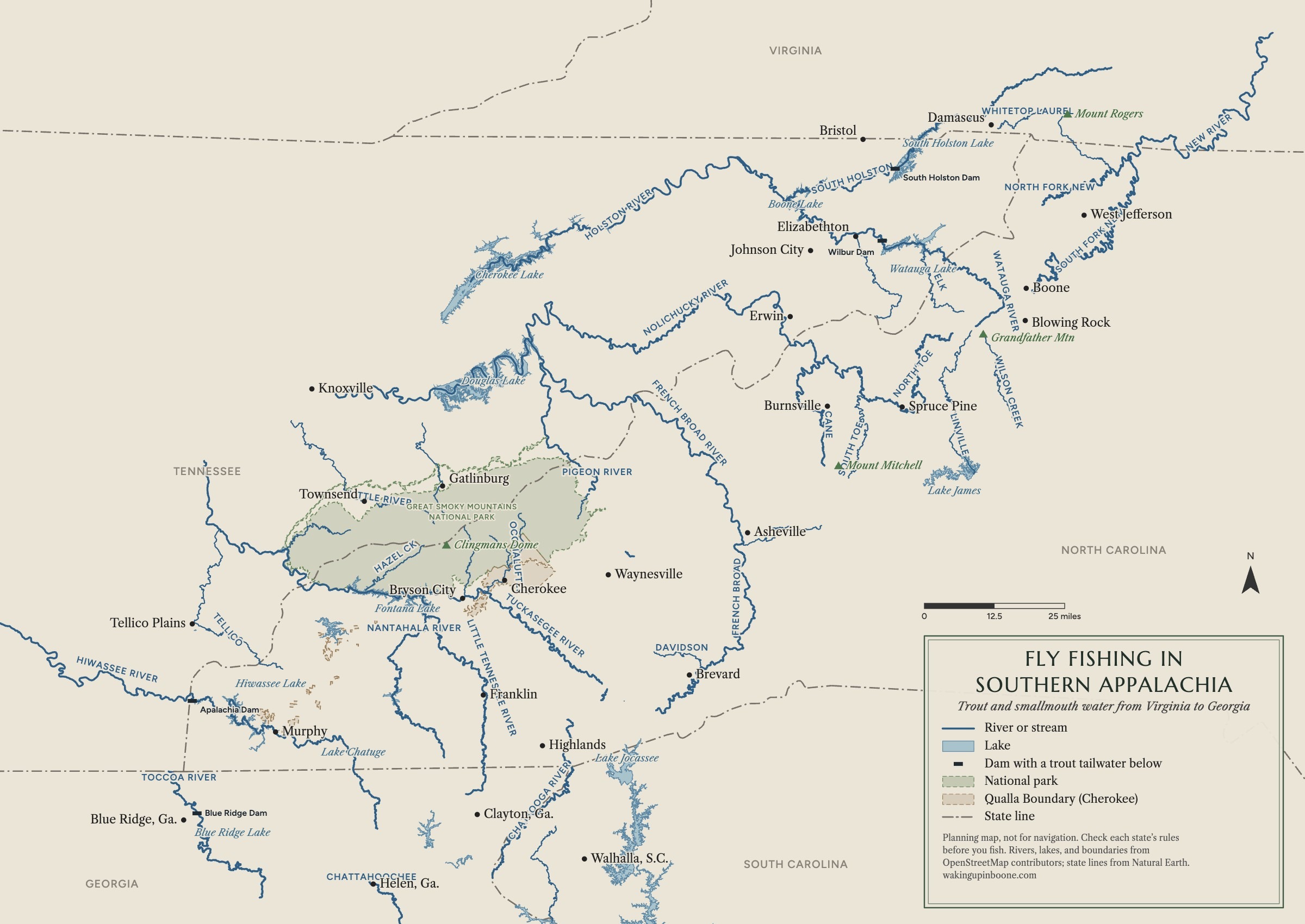
WHAT IT COVERS Trout and smallmouth bass on the fly in the mountains of Virginia, North Carolina, Tennessee, Georgia, and South Carolina, including the Smokies and the Qualla Boundary.
THE FISH Brook trout, the only trout native to these mountains, in the high headwaters. Wild rainbows and browns lower down. Stocked trout in roadside water. Smallmouth in the bigger, warmer rivers.
LICENSES Each state sells its own, and several require a trout license or privilege on top of the fishing license. A Tennessee or North Carolina license covers the Smokies. Cherokee waters require a tribal permit instead of a state license.
BEST SEASONS Spring hatches from late March through May on freestone streams. Summer in the high brook trout water and on the tailwaters. Fall for browns and stocked water. Winter on the tailwaters and Delayed Harvest water.
STOCKING North Carolina expects about 65 percent fewer stocked trout for roughly three years starting in 2026 while its largest hatchery is rebuilt. Wild trout water is the steadier bet until then.
WATER TEMPERATURE Trout are stressed above about 68°F. Carry a thermometer in summer and move up the mountain when the low water gets warm.
AFTER HELENE Most streams and accesses have reopened. Some channels changed completely, so old directions to named pools may be wrong.
ONLINE GUIDES NC WILDLIFE TROUT | TENNESSEE TROUT RULES | VIRGINIA TROUT | GEORGIA TROUT | SMOKIES FISHING
In this guide
What Helene changed
Helene’s remnants hit these mountains on September 27, 2024. The hardest-hit drainages were the Nolichucky, the Toe and the Cane, the Swannanoa and upper French Broad, the Doe, and the Watauga. Two years later, the fish have come through better than the streams did.
The fish. In 2025, North Carolina Wildlife Resources Commission crews surveyed close to 200 streams, more than the 150 or so they normally sample in a year. Jake Rash, who oversees the state’s trout program, told Trout Unlimited that most streams had fewer fish than before but that trout were still there, including in small tributaries whose channels had been torn apart. He expected numbers to return to pre-storm levels in two to three years. Brook trout surveys in the spring of 2025 found that many native populations survived. In Tennessee, the Tennessee Wildlife Resources Agency’s first sampling on the Watauga tailwater after the storm found good numbers of trout.
Fly fishing guide Judson Conway, who has guided out of Boone since the early 1990s, told Waking Up in Boone in late 2024 that in every flood he has fished through, the fishing afterward was about the same as before. In his experience, most trout hold behind rocks and stay put. The ones that die are the fish that move into shallow, slower water during the flood and are stranded when it drops.
The insects. State water quality biologists sampled heavily damaged streams in the winter after the storm and found that they kept much of their usual variety of aquatic insects, though in lower numbers. By 2026 the numbers had largely recovered.
The streams. The lasting damage is to habitat. Conway described some small streams near Boone as “gorged out”: the flood moved every rock and stripped the logs, vegetation, soil, and sand, leaving cold water, sun, and bare rock. He named Laurel Creek in Watauga County and the Elk River near Banner Elk as examples. Other streams show no sign of the storm. Where a channel was scoured, the logjams and deep pools trout use for cover are gone, and old directions to a named pool may no longer be accurate. Some anglers expect that losing shade along south-facing streams will make them warmer in summer, though that has not been measured.
Stocking. The storm destroyed hundreds of thousands of fish at the Armstrong State Fish Hatchery in McDowell County, and a heat event there in 2026 killed about 100,000 more and delayed that fall’s Delayed Harvest stocking by a month. Separately, the state’s largest trout hatchery, Setzer in Transylvania County, is closed for a $50 million renovation. The commission expects stockings of Hatchery Supported and Delayed Harvest water to drop by about 65 percent for roughly three years starting in 2026, with most stocking packed into spring and fall. Through at least 2027, wild trout water in North Carolina will fish more consistently than stocked water.
Access. By September 2025 the Forest Service had reopened 97 percent of roads, 93 percent of trails, and 85 percent of recreation sites on the Pisgah and Nantahala national forests. The South Toe’s Black Mountain and Briar Bottom campgrounds reopened September 25, 2026, and the Nolichucky’s Poplar Boat Launch reopened June 12, 2026. As of October 2026 the Blue Ridge Parkway was open without a break from Virginia to Little Switzerland, which matters for Parkway water like Boone Fork and Price Lake. The Rivers of the High Country guide has more detail on each river, and the land managers’ closure pages are listed at the end of this guide.
The fish
Brook trout
The brook trout is the only trout native to the southern Appalachians. It is technically a char. Brook trout in the New River watershed in Virginia and everywhere south of it, including every stream in the Smokies, are genetically distinct from northern brook trout, and a 2022 study of more than 22,000 fish from Georgia to Quebec found that populations differ from one drainage to the next. Many southern populations are very small.
Logging, the floods that followed it, and the stocking of rainbows and browns cost brook trout 70 to 80 percent of their stream miles in the region during the 20th century. In the Smokies they once lived as low as about 1,600 feet and are now gone from every park stream below 3,000 feet. In Tennessee, TWRA counts about 150 brook trout streams, all above 3,000 feet.
Brook trout live in small, steep, shaded headwaters, usually above a waterfall or other barrier that keeps rainbows out. Food is scarce there, so they rise readily to ants, beetles, and inchworms that fall into the water. In the Smokies they live three or four years and top out at 9 to 12 inches. They spawn in October and November and are the least tolerant of warm water of the three trout.
Rainbow trout
Rainbows are native to the Pacific drainages of western North America. They were brought to Tennessee in the late 1880s after logging destroyed brook trout habitat, and logging companies and others began stocking them in what became the Smokies around 1910. The park stocked rainbows until 1975. Rainbows are now the most widespread trout in the region, with wild populations in about 300 east Tennessee streams. Wild rainbows spawn in February and March. The palomino and golden trout you may see in stocked water are color strains of rainbow trout.
Brown trout
Browns came from Europe in the late 1800s. They live in the larger, lower reaches of freestone streams and in the tailwaters, often alongside rainbows, and TWRA counts wild browns in about 25 Tennessee streams. Browns live about twice as long as rainbows and brook trout and grow larger. Big browns eat fish, crayfish, and salamanders and feed most in low light and after dark. They spawn in October and November, which is why some tailwater spawning areas close in the fall.
Smallmouth bass
Smallmouth are native to the rivers that drain west of the mountains to the Mississippi: in North Carolina, the French Broad, Hiwassee, Little Tennessee, New, and Watauga basins. They were introduced into Atlantic-slope rivers like the Catawba and the Yadkin. North Carolina’s surveys found most river smallmouth average 8 to 10 inches, with a few near 20. Adults eat mostly minnows and crayfish and hold near current and cover: logs, ledges, and boulders. Virginia’s Department of Wildlife Resources says pre-spawn activity starts in mid to late March, and smallmouth spawn from late April through May once the water passes about 60°F, with males guarding nests on gravel in 2 to 4 feet of water.
The biggest threat to them is the Alabama bass, which anglers illegally introduced into North Carolina in the early 1980s. Alabama bass interbreed with smallmouth, and over time the hybrids can replace smallmouth in a river or lake. North Carolina expects that to happen in Lake James. Never move bass from one water to another.
Five kinds of water
Each kind of water fishes differently and falls under different rules, so it helps to know which one you are standing in.
- High headwaters. Small, steep, shaded brook trout streams, mostly above 3,000 feet. Fish are small and willing, and a dry fly works most of the season. They are usually under wild trout or park rules: single-hook artificial lures only.
- Freestone streams. Mid- and low-elevation streams with no dam, fed by rain and springs. Wild rainbows dominate, with browns in the bigger, lower water. Flow and temperature rise and fall with the weather, and in a hot summer the lower reaches can pass 68°F. Below about 2,500 feet in the Smokies, the streams widen and slow and hold smallmouth and rock bass along with or instead of trout.
- Stocked water. Usually lower, roadside water with easy access. In North Carolina this is Hatchery Supported and Delayed Harvest water. Delayed Harvest streams are stocked heavily from fall to spring and are catch and release during that time.
- Tailwaters. Rivers below dams that release cold water from the bottom of the lake, so trout stay active all year and hatches last for weeks. TVA’s trout tailwaters in this region are the South Holston below South Holston Dam, the Watauga below Wilbur Dam, the Hiwassee below Apalachia Dam, and the Toccoa below Blue Ridge Dam in Georgia. The water can rise fast and without warning when the generators start.
- Smallmouth rivers. The bigger, warmer rivers: the New, French Broad, Nolichucky, Pigeon, Little Tennessee, lower Tuckasegee, Hiwassee, and the Holston system. Smallmouth need clean, clear water and do poorly with silt and heat.
Where to fish
This is an overview of the main areas from north to south, not a list of every stream. For any stream, check how it is classified and whether it crosses private land before you go.
The High Country
Around Boone, Blowing Rock, and Banner Elk, the Delayed Harvest water includes two sections of the Watauga near Valle Crucis, the South Fork New River from Todd Island to the Castle Ford Road bridge, and parts of the Elk below Banner Elk are stocked. The South Fork New through Boone from the US 421 canoe launch to Brookshire Park is stocked, and Judson Conway suggests the river along Blowing Rock Road and Brookshire Park as easy places for a beginner to start. Laurel Creek, which runs to the Watauga near Valle Crucis, has a Catch and Release, Artificial Flies and Lures Only section above stocked water. The Elk on the Lees-McRae College campus is catch and release, and much of the rest of the Elk is private. Conway calls the Elk a good, scenic local river, but not the nationally known river some visitors have heard it is.
On the Blue Ridge Parkway, Boone Fork and Price Lake are reached from the Julian Price Memorial Park area. Beech Mountain’s Buckeye Creek and Buckeye Creek Reservoir are Mountain Heritage Trout Water, where an $8 three-day license is enough (see the North Carolina rules below).
The New River below the forks, in Ashe and Alleghany counties and on into Virginia, is the region’s closest smallmouth river to Boone. Conway guides on it, and outfitters float it for smallmouth and muskie. North Carolina and Virginia licenses are both honored on the New from the confluence of the North and South forks to the mouth of the Little River in Grayson County, Virginia. The winter fishing story on this site follows Conway on a frozen New in January.
The Toe, the Cane, the Nolichucky, and the Linville
The North Toe through Spruce Pine and the Cane near Burnsville are Delayed Harvest water. The upper South Toe below Mount Mitchell is Catch and Release, Artificial Flies and Lures Only, and the river below Clear Creek is stocked. The Nolichucky below the Toe and the Cane is smallmouth water, usually fished from rafts, and Helene changed it more than any other river in the region: new rapids, new pools, and railroad debris in the gorge. Float it with an outfitter or someone who has run it since the storm. To the south, the Linville is stocked above Linville Gorge and wild in the gorge itself, and Wilson Creek has Delayed Harvest water on the game land. The Rivers of the High Country guide gives the boundaries.
Southwest Virginia
Whitetop Laurel Creek, which runs along the Virginia Creeper Trail near Damascus, is known mainly for its browns and has two special regulation sections where only single-hook artificial lures are allowed all year. Green Cove Creek and Big and Little Wilson creeks in Grayson Highlands State Park and the Mount Rogers National Recreation Area are also special regulation trout water. Helton Creek, which starts near Mount Rogers and runs into North Carolina, has its own guide on this site. Chestnut Creek in Carroll County is Delayed Harvest water. Virginia’s special regulation waters each have their own size and creel limits, so look the stream up on the Department of Wildlife Resources site before you fish it.
The Tennessee tailwaters
The South Holston below South Holston Dam is known for its sulphur hatch and its wild browns. The Watauga below Wilbur Dam, through Elizabethton, is stocked with rainbows from March through December and has a Quality Trout Fishing Area with its own rules. Both are often fished from drift boats when the generators are running and on foot when they are off. Farther south, the Hiwassee below Apalachia has Delayed Harvest rules in winter. On all three, check the TVA release schedule before you wade.
Conway said the South Holston came through Helene unaffected. The Watauga tailwater ran muddy for months as sediment from Watauga Lake passed through the dam.
The Smokies and Cherokee
Great Smoky Mountains National Park does not stock fish. Brook trout hold the high streams, wild rainbows are the most widespread trout, and browns live in the larger, lower streams. Abrams Creek and the Little River hold smallmouth in their lower reaches, though Tennessee has a precautionary consumption advisory for smallmouth from both. Cataloochee took the park’s worst damage from Helene and reopened in part in April 2025. Check the park’s closure page before a backcountry trip, because some foot logs and bridges were still out in 2026.
On the Qualla Boundary, about 30 miles of the Oconaluftee River, Raven Fork, Soco Creek, and Bunches Creek are stocked Enterprise Waters open to the public with a tribal permit. A 2.2-mile section of Raven Fork above the Blue Ridge Parkway crossing is catch-and-release trophy water for fly fishing only.
The Pisgah and Nantahala forests
West and south of Asheville, the trout rivers include the Davidson near Brevard, the Tuckasegee, and the Nantahala. Parts of the Tuckasegee and the Nantahala run below dams, so check the release schedule before you wade. Trout water on the Pisgah and Nantahala game lands is Wild Trout water unless signs say otherwise.
North Georgia and the Chattooga
Georgia stocks about 160 streams from late March through October, and the Chattahoochee National Forest holds most of the public water. The Toccoa below Blue Ridge Dam is a TVA tailwater. The Chattooga River, which forms the line between Georgia and South Carolina, has Delayed Harvest water in South Carolina from the SC 28 bridge upstream about two and a half miles to Reed Creek, and either state’s license is good on the river up to the North Carolina line.
Licenses and rules by state
The five states sort their trout water differently. Below is how each system works as of the 2026–27 rules. The current digest is the authority, and every state changes something each year.
North Carolina
Anglers 16 and older need an inland fishing license to fish Public Mountain Trout Waters. The streams are posted with colored signs that show the rules:
- Hatchery Supported (green): Seven trout a day, no size limit, no bait restrictions. Closed from March 1 until 7 a.m. on the first Saturday in April while it is stocked.
- Delayed Harvest (black and white diamond): From October 1 until a half hour after sunset on the Friday before the first Saturday in June, catch and release with single-hook artificial lures only, and no natural bait in your possession. The water then opens at 6 a.m. Saturday to anglers under 16 only until noon, and after that it is fished under Hatchery Supported rules through September 30.
- Wild Trout (blue and yellow): Open all year. Single-hook artificial lures only. Four trout a day, 7-inch minimum. All trout water on game lands is Wild Trout water unless it is posted otherwise.
- Wild Trout/Natural Bait: Like Wild Trout, but natural bait other than live fish is allowed.
- Catch and Release/Artificial Flies and Lures Only (red and yellow): Open all year. Single-hook flies and lures. No trout may be kept.
- Special Regulation: Rules written for one water, such as the Catawba below Lake James.
Dropper flies are legal on all Public Mountain Trout Waters. Mountain Heritage Trout Waters are designated stretches in or next to 17 mountain towns where an $8 three-day license covers you in place of the inland license. North Carolina’s Free Fishing Day is July 4.
Tennessee
You need a fishing license and a trout privilege. Children 12 and under need no license. The statewide limit is seven trout a day with no minimum length, but many waters have their own rules:
- South Holston (South Holston Dam to the Route 37 bridge at Bluff City): All trout from 16 to 22 inches must be released. Seven trout a day, with only one over 22 inches. Spawning areas are closed to all fishing from November 1 through January 31.
- Watauga below Wilbur Dam: The Quality Trout Fishing Area from Smallings Bridge down to the CSX railroad bridges has a 14-inch minimum, a two-trout limit, and no bait.
- Hiwassee (Apalachia Powerhouse to the L&N Railroad Bridge): Delayed Harvest from October 1 through February. From March through September, seven trout, only two of them browns.
- Tellico and Citico creeks require a separate permit, and Gatlinburg’s city streams require a Gatlinburg permit and are closed Thursdays.
Great Smoky Mountains National Park
A North Carolina or Tennessee license is good anywhere in the park, and no trout stamp is needed. The park does not sell licenses. Park rules are a 7-inch minimum, a five-fish possession limit, and single-hook artificial lures only. Up to 20 rock bass may be kept in addition. Bait is prohibited, including chumming with corn or bread. It is illegal to move rocks to build channels or dams. Brook trout fishing was banned in the park from 1976 until 2006, and the last closed stream, Lynn Camp Prong, reopened in 2015 after a brook trout restoration.
Cherokee (the Qualla Boundary)
Anyone 12 and older needs a tribal fishing permit, which replaces the state license inside the Boundary. Only the Enterprise Waters are open to the public; all other reservation water is for tribal members. Catch-and-keep season opens the last Saturday in March, and the water closes to non-members for two weeks before that. The limit is ten fish a day. The trophy water on Raven Fork requires a special permit in addition to the general one. Permit prices are posted at fishcherokee.com.
Virginia
Trout season is open all year. The statewide limit is six trout a day with a 7-inch minimum. A trout license is required in addition to the fishing license to fish designated stocked trout water from October 1 through June 15. Stocked waters are graded A, B, or C by how often they are stocked, and fishing on them is limited to 5 a.m. to an hour after sunset. Trout Heritage Day is the first Saturday in April. Special regulation waters range from bait-allowed water to fly-only trophy water, and droppers are legal where single hooks are required. Virginia changed its license fees in August 2026, so check the current prices. Both Virginia and North Carolina licenses are good on Blue Ridge Parkway waters in Virginia.
For smallmouth, Virginia’s statewide limit is five black bass a day combined.
Georgia
Trout fishing is open all year. Anglers 16 and older need a fishing license and a trout license. The general limit is eight trout a day. Delayed Harvest water is catch and release with single-hook artificial lures from November 1 through May 14. Georgia and South Carolina honor each other’s licenses on the Chattooga up to the North Carolina line, but not on its tributaries.
South Carolina
Anglers 16 and older need a freshwater fishing license. South Carolina started its Delayed Harvest program on the Chattooga and Cheohee Creek in 2002. Its Delayed Harvest water is catch and release with single-hook artificial lures from November 1 through May 14 and now includes sections of the Chattooga, the Chauga, the Eastatoee, Devil’s Fork, and Cheohee Creek. North Carolina and South Carolina have no license agreement on any shared water.
Smallmouth in North Carolina
The statewide smallmouth limit is five a day, with exceptions on some waters, including the New River in Alleghany County. Check the digest for the river you plan to fish.
Seasons and hatches
Hatches start earliest on the lowest streams and move up the mountain as the water warms, so a hatch that is over in Bryson City in early April may not have started on a creek at 4,000 feet. The chart below is based on the North Carolina Wildlife Resources Commission’s hatch chart for freestone streams. Treat the months as a guide, not a schedule.
| Months | Insect | Time of day | Hook size | Flies |
|---|---|---|---|---|
| Jan to Mar | Midges | Afternoon | 18 to 24 | Griffith’s Gnat, small gray or olive midge |
| Feb to Mar | Blue-winged olive | Early afternoon, warm days | 18 | BWO, Adams |
| Feb to Mar | Early black stonefly | All day | 18 | Black stonefly, black Elk Hair Caddis |
| Late Mar to early Apr | Quill Gordon | Early afternoon | 12 to 14 | Quill Gordon, Adams |
| Late Mar to early Apr | Blue quill | Morning to early afternoon | 16 to 18 | Blue Quill, Adams |
| Apr | Hendrickson | All day | 14 | Hendrickson, Red Quill |
| Mid-Apr to May | March brown | All day, off and on | 12 | March Brown, Adams |
| Mid-Apr to early May | Black caddis | Mid-morning on | 14 to 16 | Dark Elk Hair Caddis, Thunderhead |
| Apr to Jun | Mottled brown caddis | All day, off and on | 12 to 16 | Elk Hair Caddis, Thunderhead |
| May to Jul | Sulphurs | Late afternoon and evening | 14 to 18 | Sulphur, Yellow Humpy, Yallerhammer |
| May to Sep | Light Cahill | Afternoon to dusk | 14 to 18 | Light Cahill |
| Jun to Jul | Yellow sally | Late afternoon | 14 to 16 | Yellow Sally, Stimulator, Tellico Nymph |
| Jul to Aug | Golden stonefly | Early morning and dusk | 6 to 12 | Stimulator |
| Jun to Sep | Ants, beetles, inchworms, crickets | All day | Various | Inchworm, black ant, beetle, Royal Wulff |
| Oct to Dec | Midges, BWOs, black stoneflies | Afternoon | 18 to 24 | As above |
Winter
Trout move less when the water is 40°F or colder, so nymphs fished slowly through the deeper runs catch more fish than dry flies. On warm afternoons, midges, blue-winged olives, and little black stoneflies hatch on both freestone streams and tailwaters. Delayed Harvest water and the tailwaters are the main winter fishing. Smallmouth fishing in the mountain rivers is slow until March.
Spring
Late March through May is the main season on freestone streams, starting with Quill Gordons and blue quills and running through Hendricksons, March browns, and caddis. When the water is still too cold for the mayflies, a dry fly with a small nymph dropped below it covers both. On the South Holston, sulphurs start showing on warm days in March and build through May. On the Watauga tailwater, caddis hatch in February and March. Smallmouth start feeding before the spawn in late March, and streamers like the Clouser Minnow and crayfish patterns work along current seams and behind boulders.
Summer
When the lower streams warm past 68°F, fish early in the day, carry a thermometer, and go higher. The high brook trout streams and the tailwaters are the summer trout water. Ants, beetles, and inchworms work almost everywhere, and yellow sallies hatch in the late afternoon. Summer is the main season for smallmouth on topwater, with poppers and foam bugs. Virginia’s fisheries staff say smallmouth handling deaths rise sharply once the water reaches 85 to 87°F, so land and release fish quickly in hot weather.
Fall
Land insects work into early October, and then the hatches shift back to blue-winged olives and midges. Brook and brown trout spawn in October and November. North Carolina restocks its Delayed Harvest water starting October 1, and Georgia and South Carolina on November 1. On the South Holston, browns feed hard before the spawn, and the spawning areas close November 1. September and October are good topwater months for smallmouth until fall rains raise the rivers.
Tackle
A 9-foot rod for a 4- or 5-weight line with a floating line handles most of the water in this guide. Beyond that, the right setup depends on the water.
- Small brook trout streams: A 7- to 8-foot rod for a 3- or 4-weight line, a short leader of 6 to 7.5 feet, and 5X or 6X tippet. Most casts are short, and the trees are close.
- Freestone streams and Delayed Harvest water: An 8.5- to 9-foot 4- or 5-weight, a 9-foot leader, and 4X to 6X tippet.
- Tailwaters with dry flies: A 9- to 9.5-foot rod for a 4- to 6-weight line and a leader of 12 feet or more down to 6X or 7X. The fish see a lot of flies and see them in slow, clear water.
- Tailwaters with streamers: A 9-foot 6-weight or heavier with a sinking or sink-tip line and 0X to 2X tippet, usually fished from a boat when the generators are running.
- Smallmouth: Virginia’s fisheries staff recommend an 8- to 9-foot rod for a 4- to 7-weight floating line, a 7- to 10-foot leader, and 3- to 5-pound tippet for small bugs. A 6-weight handles poppers and streamers. A sinking line helps with streamers in the spring.
Tight-line or “Euro” nymphing, with no indicator and a long, thin leader, is widely taught in the region and catches fish when they are feeding below the surface, which is most of the time. Indicator nymphing is standard on the tailwaters. Swinging wet flies downstream is an old method that still works well on Delayed Harvest water.
Other gear. Waders from late fall to late spring; many anglers wade wet in summer. Studded rubber soles help on slick rock. We found no felt-sole ban in these five states or the Smokies as of November 2026, but check before you go. Bring a stream thermometer, polarized glasses, a rain jacket, and a headlamp for evening hatches. Wear a life jacket on any float trip.
Flies
A few patterns started in these mountains, and three of them are on North Carolina’s own hatch chart.
- Yallerhammer. The best-known traditional southern Appalachian fly, fished as a wet fly, nymph, or dry. It was first tied with a split wing feather from the yellow-shafted flicker, a woodpecker called the yellowhammer in the mountains. Some say the Cherokee devised it, but its origin is uncertain. The flicker is protected under the Migratory Bird Treaty Act, so it is illegal to possess its feathers. Tyers now use dyed dove, quail, grouse, or chicken feathers.
- Tellico Nymph. One of the two southern flies that came into wide use elsewhere. One account credits a priest fishing the Tellico River in the mid-1920s, and others credit Fred Hall. It is fished as a yellow stonefly imitation.
- Thunderhead. Fred Hall’s high-floating dry fly for rough pocket water in the Smokies, a good general attractor for brook trout.
Other old regional patterns include the Sheep Fly, the Jim Charley, the Smoky Mountain Forktail, the Tennessee Wulff, and the Yellow Palmer. Roger Lowe’s Fly Pattern Guide to the Great Smoky Mountains documents 101 traditional patterns.
A basic box for trout: Parachute Adams (12 to 18), Elk Hair Caddis (14 to 16), Thunderhead (12 to 14), Yallerhammer (10 to 14), Tellico Nymph (10 to 14), Pheasant Tail and Hare’s Ear nymphs (14 to 18), Zebra Midge (18 to 22), blue-winged olive nymphs and dries (18 to 22), and a Woolly Bugger (6 to 10). Add Quill Gordons and Hendricksons in spring, sulphurs from May, Yellow Sallies and Stimulators in summer, and ants, beetles, and inchworms from June into October.
For smallmouth: a popper such as a Boogle Bug, a foam beetle or cicada, a Clouser Minnow, a Half and Half, and crayfish and hellgrammite patterns.
Before you fish egg patterns or soft worm flies on Wild Trout or Delayed Harvest water, check that they meet that state’s definition of an artificial lure. North Carolina’s definition excludes anything treated with scent.
Public water and private land
National forests, the Smokies, the Blue Ridge Parkway, state game lands, and state parks are open to fishing under the rules above. In every state, you need the owner’s permission to cross private land to reach water. Whether you can wade and fish a stream where it runs through private land depends on the state.
- North Carolina treats a stream as navigable, and its bed as public, if it can be paddled in a canoe or kayak in its natural condition. On those streams you may wade and fish, but you still cannot cross private land to get there. Small streams that cannot float a canoe can be private. Much of the state’s designated trout water runs through private land whose owners allow public fishing. Signs that say “Access for Fishing Only” mean exactly that: fish, and do not camp, build fires, swim, or launch boats unless the owner allows it.
- Virginia allows private ownership of streambeds under colonial land grants, and its Supreme Court upheld exclusive private fishing rights on part of the Jackson River in 1996. There is no central record of which streams are affected, so stay on Department of Wildlife Resources public water and public land, and ask permission elsewhere.
- Tennessee holds the beds of legally navigable rivers as public. On smaller streams the bed belongs to the landowner, though the public may pass through. TWRA says you must have permission to fish on private property. Use the agency’s access areas on the tailwaters.
- Georgia passed a law in 2024 that lets the public fish and travel on navigable streams even where the bed is privately owned, without entering the land beside them. Most north Georgia trout streams are probably too small to count as navigable, so stick to national forest and state land.
A lawsuit by a property owners’ association over short stretches of Boone Fork and the Watauga temporarily closed that water in 2024. The case ended in January 2026, and American Whitewater says the public’s right to paddle those stretches stands. Check with the Wildlife Resources Commission about fishing there.
Some streams near Boone that were once hard to reach now have fewer homes along them because of Helene. The land still belongs to the families who lost those homes, and the same rules apply.
A short history
The Cherokee fished these rivers long before settlers came, and some of the region’s fly patterns may have Cherokee roots, though those stories are folklore. By the late 1800s, local men fished with homemade tackle and braided horsehair lines, and printed accounts describe catches of hundreds of trout a day before the logging began. Mark Cathey of Indian Creek, who died in 1944, was a logger, surveyor, and guide and the best-known fly fisherman of his time in the Smokies. Sam Hunnicutt recorded many trips with him in Twenty Years Hunting and Fishing in the Great Smokies. Horace Kephart, who lived among the trout streams of Hazel and Deep creeks, photographed anglers in 1904 using long rods with no reels.
Clear-cut logging began in the 1880s, and the logging and the floods that followed it wiped out many brook trout populations between about 1900 and 1935. Wealthy fishing clubs bought long stretches of the best streams and closed them. Rainbows, browns, and northern brook trout were stocked to replace what was lost.
Fred Hall and his wife tied flies for local and visiting anglers and gave the region the Tellico Nymph, the Thunderhead, and the Adams Variant. In the second half of the 20th century, the Smokies closed brook trout fishing in 1976 and began restoring native brook trout in 1986, and park biologists have since restored them to more than 27 miles of 11 streams. North Carolina started Delayed Harvest in the early 1990s, the first state in the Southeast to do so, and drift boats and the Tennessee tailwaters changed how many people fish here. The Fly Fishing Museum of the Southern Appalachians, now on Island Street in Bryson City, keeps that history.
Taking care of the fish
- Watch the temperature. Stop fishing for trout when the water passes about 68°F, and stop sooner for brook trout.
- Stay off the redds. Brook and brown trout spawn on clean gravel in October and November. Walk around those beds rather than across them.
- Clean and dry your gear. Didymo, an invasive algae, is in every east Tennessee tailwater, including the South Holston and the Watauga. A park study did not find it in Smokies streams. If you fish a tailwater and the park on the same trip, clean and fully dry your boots and waders in between.
- Leave the rocks. Moving rocks to build dams or channels is illegal in the Smokies, and hellbenders den under big flat rocks in the rivers west of the divide.
- Don’t move fish. Moving Alabama bass is what is driving smallmouth out of some rivers.
- Report violations. In North Carolina, call the Wildlife Resources Commission at 1-800-662-7137. In the Smokies, call park dispatch at (865) 436-1294.
Before you go
- Map: The download map in the At a Glance box shows the rivers, lakes, tailwater dams, and towns in this guide. It is a planning map, not a navigation map.
- Regulations: North Carolina | Tennessee | Virginia | Georgia | South Carolina | Great Smoky Mountains National Park | Cherokee
- Stocking: North Carolina posts its stocking at ncwildlife.gov/trout. TWRA and Virginia post schedules on their sites. South Carolina posts weekly summaries after stocking, not before.
- Tailwater releases: TVA posts the next day’s schedule by about 6 p.m. on its website and in the free TVA Lake Info app, or call 1-800-238-2264. The water can rise at any time.
- Closures: National Forests in North Carolina | Smokies road and trail closures | Blue Ridge Parkway road status
- Water levels: waterdata.usgs.gov. The Rivers of the High Country guide lists the gauges for the High Country rivers.
- Guides: If you are new to this water, a day with a local guide is the fastest way to learn it. Judson Conway runs trips for trout, smallmouth, and muskie at ecoflyfishing.com.
Details checked November 2026. Rules change every year and Helene repairs are still under way, so check the state digest and the land manager’s page before you go.
More on fishing: Fishing in a Winter Wonderland | Rivers of the High Country | Big Helton | Boone Fork
New stories from the mountains delivered to your inbox.


